

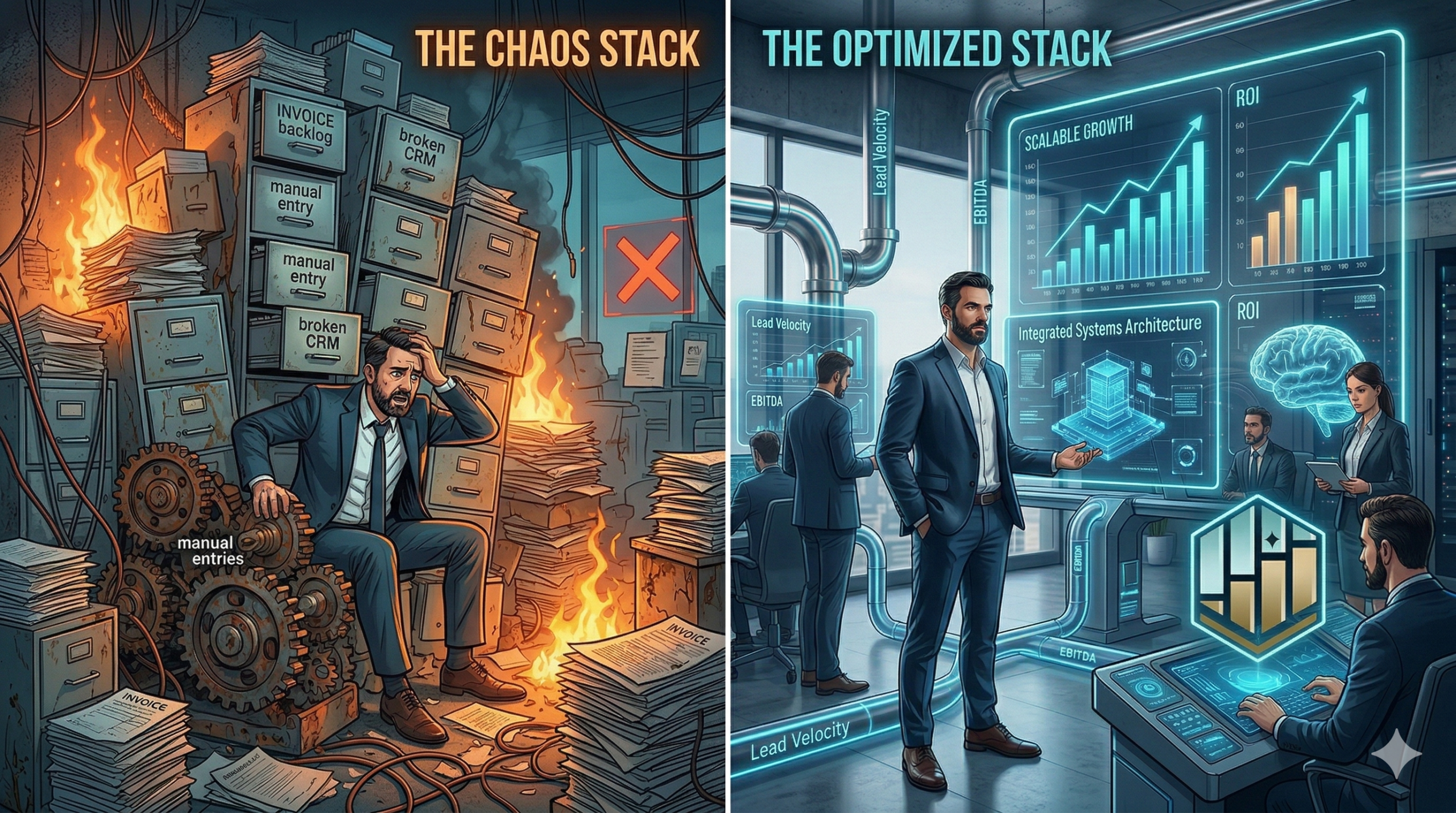
It is the classic scaling trap: Sales are accelerating, but complexity is growing faster.
When your business hits that critical inflection point, the instinct is usually to hire. You need more hands. More bandwidth. But if those new hires are entering a chaotic system of spreadsheets, manual checklists, and overlapping tools, all you have done is scale your bottlenecks.
To break past $3M without contracting, you don’t need an expanded HR department. You need Operational Infrastructure.
Defined: The Infrastructure of Scale
If your business were a modern building, sales would be the facade—what the world sees. Your operational infrastructure is the core, the structural beams, and the complex utility pipes. It is invisible from the street, but without it, the structure cannot support additional weight.
This means moving from a reactive operation (chaos and manual fixes) to a proactive, automated workflow (integrated systems and precise data).
For STACK Consulting, a complete infrastructure means “The Whole Stack.” It is:
- Systematic Interconnectivity: Your CRM is the start of the process, not the end of data hygiene.
- Process Integration: A lead coming in from your website automatically triggers a nurture sequence and notifies your sales team in their PM tool.
- Measurable ROI: Operational efficiency isn’t conceptual; it is a leading indicator of revenue growth and EBITDA.
Building Your “STACK”
Scalability is the logical outcome of efficient design.
Before you add another $1M in revenue—adding strain to your current structure—audit your operational core. If your current systems are breaking under their current load, you are not ready for more users.
Leading means building the infrastructure that supports the growth you know is possible.

Leave a Reply