

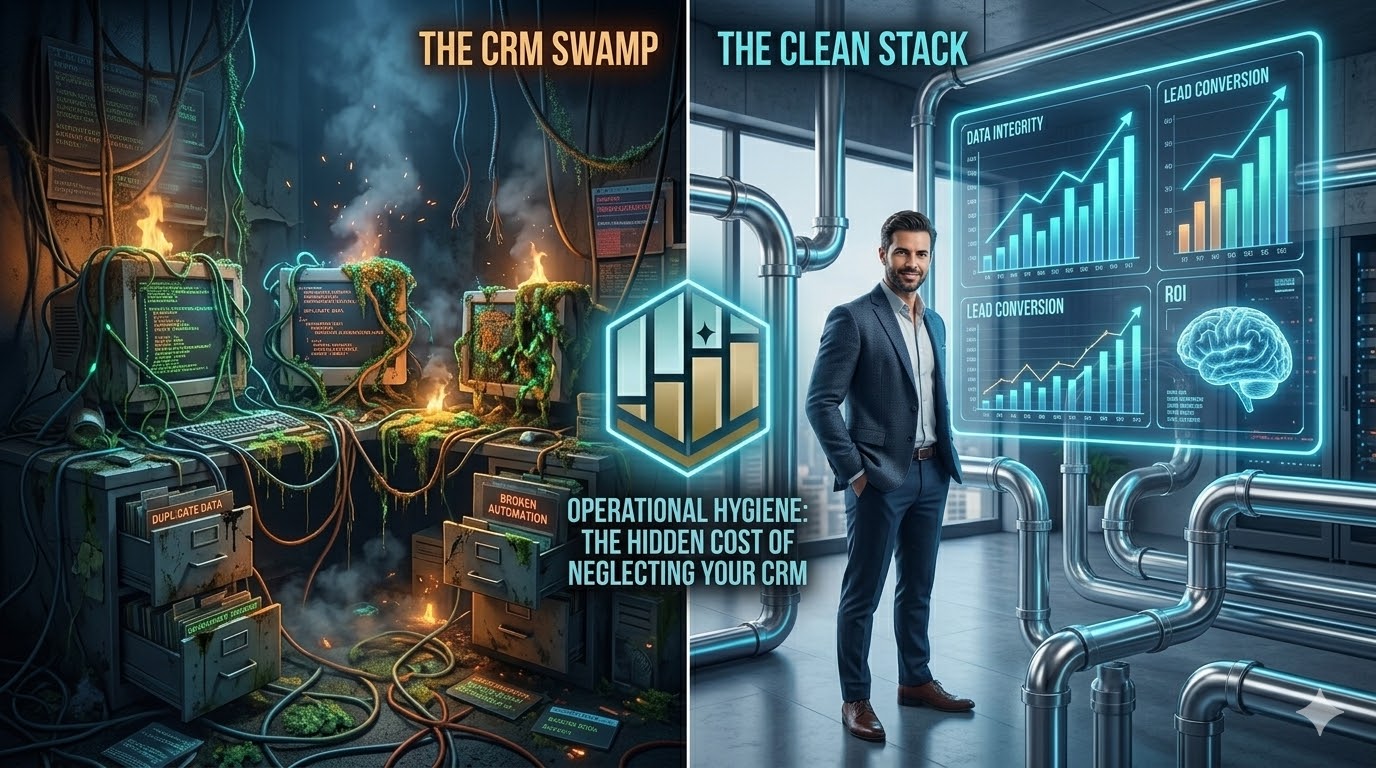
In the early days of a business, you can manage your data with a spreadsheet and a prayer. But as you scale toward the $5M mark, your CRM stops being a “digital rolodex” and starts being the central nervous system of your entire operation.
If that system is cluttered, outdated, or ignored, you aren’t just disorganized, you are paying a Complexity Tax on every single lead.
What is Operational Hygiene?
Operational hygiene is the disciplined maintenance of your data architecture. It’s the difference between a CRM that drives revenue and a “Data Swamp” where leads go to die. When hygiene is neglected, your team spends more time cleaning up duplicates and fixing broken automations than they do actually closing deals.
The 3 Signs Your CRM Has a “Hygiene” Problem:
- The Ghost Lead: You have 5,000 contacts, but you only know the status of 50. The rest are sitting in a digital graveyard with no assigned owner or last-activity date.
- Manual Workarounds: Your team has stopped using the CRM’s built-in features because “it’s too confusing,” and they’ve reverted to keeping private notes or separate spreadsheets.
- Reporting Friction: When you ask for a simple conversion report, it takes your team three days to compile it manually because the data isn’t standardized.
The Solution: The “Whole Stack” Cleanse
At STACK Consulting, we don’t just “fix” CRMs; we install a protocol for ongoing hygiene. We move businesses from a state of reactive firefighting to proactive growth by:
- Standardizing Inputs: Ensuring every lead enters the system with the same mandatory data points.
- Automated Pruning: Using logic to archive “dead” leads and surface high-intent opportunities automatically.
- Single Source of Truth: Integrating your marketing and sales stacks so that data flows bi-directionally without human intervention.
Clean data is the fuel for automation. If the fuel is dirty, the machine breaks.

Leave a Reply